
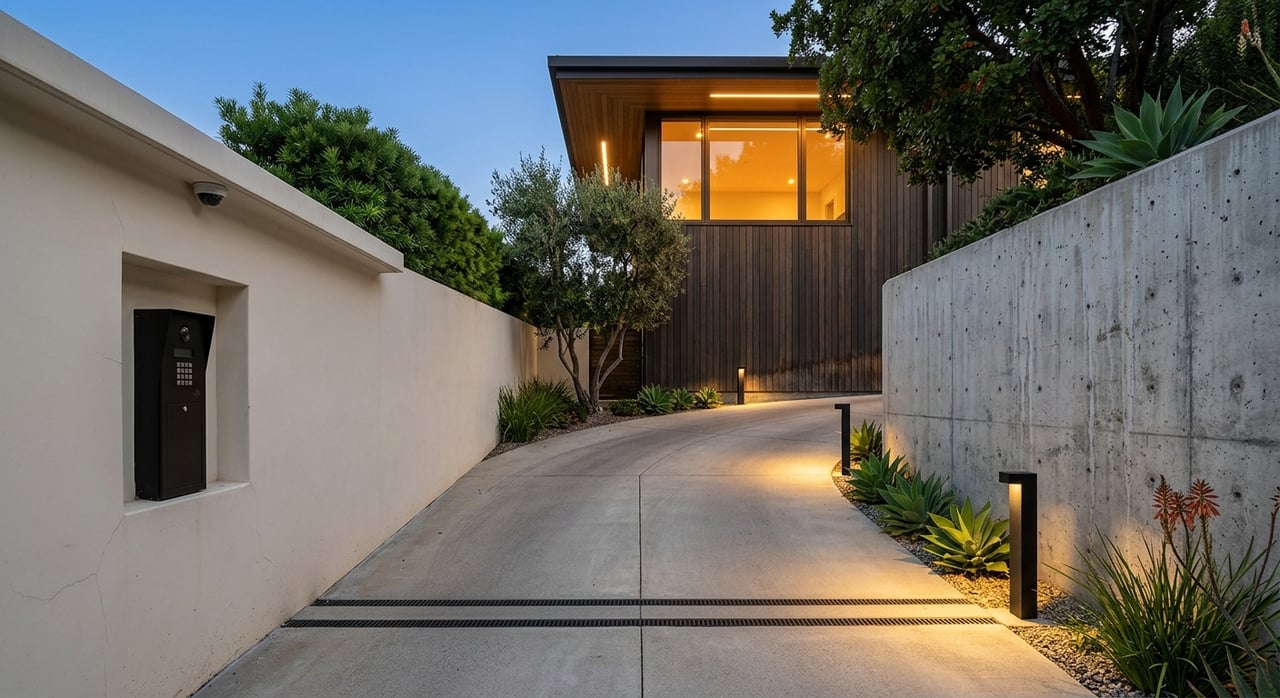
If you are shopping or selling in the Hollywood Hills, a gate can look like a simple luxury feature. In reality, gated streets and private drives often raise bigger questions about access, maintenance, disclosures, and long-term value. Understanding how these roads work can help you evaluate a property more clearly and avoid surprises later. Let’s dive in.
Why gated access is common here
The Hollywood Hills is a hillside area that stretches across the Santa Monica Mountains and includes areas such as Outpost Estates, Laurel Canyon, Beachwood Canyon, Hollywood Dell, Nichols Canyon, and Mt. Olympus. Because the terrain is steep and irregular, the street pattern is often winding rather than grid-based.
That layout creates short blocks, dead ends, narrow approaches, and limited turnarounds. In practical terms, this is one reason private drives and gated access appear more often here than in flatter parts of Los Angeles.
Gates in the Hills are not only about image. In some cases, residents have pursued gates because of trespassing and nuisance traffic, and similar access controls have been used on other Hollywood Hills streets for decades.
Public streets versus private drives
One of the most important questions to ask is whether the road is public, private, or a former public street that was later vacated. That distinction affects what can legally be gated, who maintains it, and what documents you should review.
A normal public street cannot simply be blocked with a security gate. According to the Los Angeles Fire Department, public-street rights-of-way may not be closed by a gate.
Private streets, access roads, and fire lanes can be gated, but only if they stay unobstructed and comply with Fire Department standards. That means a gate is not just a convenience feature. It is part of a larger access system that must work for everyday use and for emergency response.
What a vacated street means
Sometimes a road began as a public right-of-way and later changed status through a formal City process. In Los Angeles, the Bureau of Engineering explains that a street vacation ends the public right to use a street, alley, walk, or other public easement.
This is not a quick administrative step. The City says the average street-vacation process can take about 2.5 to 3 years.
If you are considering a home on a gated street, and someone says the road was "once public," that should prompt a document review. You will want to confirm whether there is a recorded resolution to vacate and how access and maintenance rights were structured afterward.
Why fire access matters so much
In the Hollywood Hills, roadway access is not a minor detail. Hillside development standards and Fire Department review place real weight on road width, paving, grade, turnarounds, and secured entrances.
The City’s hillside checklist for many single-family projects uses a 20-foot continuous paved roadway benchmark. It also requires access routes that keep structures within 300 feet of an approved hydrant.
LAFD reviews both public and private streets for issues such as width, turning radii, parking restrictions, overhead clearance, load capacity, grade, turnarounds, and secured entrances. That review is meant to improve emergency response times.
For buyers, this means a private drive should be evaluated as infrastructure, not just ambiance. For sellers, it means a well-documented and functional access setup can remove friction during diligence.
Who maintains the road and gate
This is often the biggest practical issue on a gated street. Under Los Angeles Municipal Code section 65.00, private streets must be maintained by the owners and adjacent owners so that fire, police, health and sanitation, and utility vehicles can serve the properties and turn around safely.
In plain terms, the City is not the default maintainer of a private access road. If the pavement, gate motor, lighting, or related improvements need repair, responsibility usually falls on the owners according to the recorded documents.
That can include more than the road surface itself. Depending on the setup, maintenance obligations may reach gate hardware, landscaping, retaining features, and shared lighting.
What happens if maintenance is ignored
Deferred maintenance is not just a cosmetic problem. If owners do not comply with a repair order on a hazardous private street, the City can make the repairs and charge the costs back to the owners.
The code also treats hazardous private streets as a public nuisance. That gives maintenance a legal and financial dimension that buyers and sellers should take seriously.
HOA roads, shared agreements, and reserves
Some gated streets are part of a California common interest development. In those cases, an association manages the development, and the default rule is that the association maintains the common area unless the recorded declaration says otherwise.
California law also requires an annual budget report with reserve and insurance summaries, a reserve-funding-plan summary, and statements about deferred major repairs or possible special assessments. The full reserve plan must be available on request.
This matters because dues on a gated street may support ongoing costs such as:
- Pavement repairs
- Gate motors and access systems
- Lighting
- Landscaping
- Insurance
- Reserve contributions for future repairs
The exact cost split depends on the CC&Rs and any maintenance agreement. Even where there is no formal HOA, the recorded documents still control who pays for what.
How gated access affects resale
Privacy is the main draw of a gated street or private drive. Reduced through-traffic and a more secluded arrival can be very appealing, especially in a market where discretion often matters.
At the same time, gated access can narrow the buyer pool. Some buyers are comfortable with dues, CC&Rs, gate rules, and shared infrastructure obligations. Others prefer a simpler setup and may hesitate if the documents are unclear or future costs seem uncertain.
Research on gated communities generally finds that they can command price premiums compared with similar non-gated homes, though that premium is not uniform. The takeaway is simple: a gate can support value, but not automatically.
What makes a gate a selling point
For sellers, privacy becomes a stronger marketing asset when the access story is clean and easy to understand. Buyers usually respond better when they can quickly verify the road status, maintenance structure, and emergency access setup.
In practice, a gated property tends to present better when:
- The road status is clearly documented
- The gate is operational
- Easements and title matters are clear
- Budgets and reserves appear adequate
- There are no unresolved City maintenance issues
If those items are murky, a gate can shift from a value add to a diligence concern.
Questions to ask before you buy
If you tour a home on a gated street or private drive in the Hollywood Hills, it helps to ask focused questions early. Doing so can save time and sharpen your negotiations.
Here is a practical checklist:
- Is the access route public, private, or a former public street that was vacated?
- If it was vacated, is there a recorded resolution to vacate?
- Who owns and maintains the pavement, gate hardware, lighting, landscaping, and any retaining walls?
- Is there an HOA, and if so, what do the annual budget report and reserve summary show?
- Is there any indication of deferred repairs or a possible special assessment?
- Does the gate meet LAFD standards for width, emergency override, and fail-safe opening?
- Can fire apparatus turn around, and are hydrants and access routes adequate?
- Has the City ever issued a repair order or treated the street as hazardous?
These are not niche questions. They go directly to cost, usability, safety, and resale.
What sellers should prepare in advance
If you are selling a home on a gated street, preparation matters. Privacy is attractive, but buyers still want clarity.
Before bringing a property to market, it helps to organize the access story as carefully as the design story. That may include gathering road-status records, maintenance agreements, HOA budgets, reserve information, gate details, and any relevant City paperwork.
For architecturally significant or privacy-minded homes, that preparation can support a smoother showing process and a cleaner negotiation. It also helps qualified buyers understand the value of the setting without getting stuck on uncertainty.
In the Hollywood Hills, a gate can shape first impressions, daily use, and eventual resale. The key is knowing whether that gate sits on a well-structured access system or on unanswered questions. If you want guidance on evaluating or positioning a gated property with discretion and precision, Michael Fenton can help.
FAQs
What does a gated street mean in the Hollywood Hills?
- A gated street in the Hollywood Hills may be part of a private street, access road, or other controlled entry setup, but the legal meaning depends on whether the road is public, private, or a former public right-of-way that was vacated.
Can a public street in Los Angeles be gated?
- No. LAFD states that public-street rights-of-way may not be closed by a gate.
Who maintains a private drive in the Hollywood Hills?
- Under Los Angeles Municipal Code section 65.00, owners and adjacent owners are responsible for maintaining private streets so service and emergency vehicles can access the properties safely.
What should buyers review for a gated property in California?
- Buyers should review the road status, easements, maintenance agreements, HOA documents if applicable, annual budget and reserve information, and any records related to repairs or City orders.
Do gated homes in the Hollywood Hills always sell for more?
- Not always. Research suggests gated communities can command price premiums, but the premium is not uniform and can depend on factors such as privacy, infrastructure quality, and ongoing ownership costs.
Why is fire access so important for Hollywood Hills homes?
- Hillside properties are subject to access standards involving roadway width, paving, hydrant distance, turnarounds, and gate function, all of which affect emergency response and property usability.