
You can be in the Hollywood Hills and still be shopping three very different lifestyles. That is what makes this part of Los Angeles so compelling, and sometimes so confusing, for buyers and sellers alike. If you are trying to understand how Beachwood Canyon, Laurel Canyon, and Outpost Estates really differ, this guide will help you see how access, architecture, planning context, and day-to-day feel shape value. Let’s dive in.
Why micro-neighborhoods matter
The Hollywood Hills is not one uniform market. City planning and historic-resource materials repeatedly treat hillside areas like Laurel Canyon and Outpost Estates as distinct places because character, access, and historic fabric can change noticeably from one pocket to the next.
For you as a buyer or seller, that means the broad Hollywood Hills label only tells part of the story. In practice, road geometry, emergency access, historic-preservation context, and the era of construction can all influence how a home lives and how the market responds to it.
Beachwood Canyon at a glance
Beachwood Canyon is one of the most recognizable pockets in the Hollywood Hills, in part because of its close association with the Hollywood Sign. The canyon runs from Franklin Avenue up toward Mulholland, and the historic Hollywoodland subdivision sits at the north end of Beachwood Drive near the sign.
The area has a strong sense of identity. For many buyers, Beachwood offers that classic old-Hollywood backdrop with hillside views, winding streets, and a setting that feels tied to Los Angeles history in a very visible way.
Beachwood architecture and setting
Upper Beachwood’s historic core was designed as a cohesive Period Revival community. City documentation describes Hollywoodland as a 500-acre subdivision with approved styles including French Norman, English Tudor, Mediterranean, and Spanish Colonial Revival.
The physical details matter here. Curving streets, granite retaining walls, stairways, sidewalks, and ornamental street lights help create a storybook setting that feels more intentionally composed than many hillside blocks.
Beachwood access and daily life
Beachwood Drive is the main thoroughfare through Beachwood Canyon and Hollywoodland. City records also note that upper Beachwood is closely tied to Hollywood Sign visitation, with limited parking, narrow street conditions, and emergency-access challenges.
That translates into a very specific daily experience. You may love the views, trail access, and historic character, but you also need to understand that some blocks experience more public traffic and parking pressure than buyers often expect from a hillside enclave.
Who Beachwood tends to attract
Beachwood often appeals to buyers who want Hollywoodland identity, notable architecture, and a strong sense of place. It can also attract those who value a home with narrative and visual character over a more tucked-away or purely convenience-driven location.
For sellers, micro-location matters a great deal here. A home on a quieter stretch may be interpreted differently than one on a more visitor-facing block, even if the finishes and square footage are similar.
Laurel Canyon at a glance
Laurel Canyon sits on the western edge of the Hollywood Hills and has long been shaped by its topography. The neighborhood is closely tied to its geology, winding roads, and canyon setting, and Laurel Canyon Boulevard was regraded and widened over time to improve access to the San Fernando Valley.
Even with that history, access remains central to how the area is understood. The City later applied Hillside Construction Regulation rules to Laurel Canyon because of hillside-specific issues such as substandard streets, restricted ingress and egress, below-average emergency response times, and limited pedestrian facilities.
Laurel Canyon architecture and character
One of Laurel Canyon’s biggest differentiators is its architectural range. Historical and city resources describe a mix that includes early cabins and cottage-like retreats, lower-canyon English Tudor and Spanish or Mediterranean homes, later Cape Cod examples, and postwar modern houses built into steep slopes.
The neighborhood is also associated with Mid-Century and Case Study-era design. That variety gives Laurel Canyon a layered feel, where architecture can shift quickly from rustic and intimate to crisp and modern depending on the street and the site.
Laurel Canyon lifestyle feel
Laurel Canyon is often experienced as more secluded, wooded, and inward-looking than other Hollywood Hills pockets. Open-space preservation and the compact canyon identity contribute to a setting that feels less formal and more tucked into the landscape.
That sense of privacy and atmosphere is a major draw. At the same time, the canyon’s physical realities mean that convenience can vary a lot from property to property.
What buyers should weigh in Laurel Canyon
In Laurel Canyon, character and convenience are often part of the same conversation. Homes with easier ingress, more usable pads, stronger privacy, and notable architectural pedigree tend to attract more interest than homes on tighter or more constrained streets.
For you as a buyer, the practical questions matter just as much as the aesthetic ones. A beautiful home on a dramatic site may feel very different from one with simpler access and more functional outdoor space, even within the same canyon.
Outpost Estates at a glance
Outpost Estates is one of the clearest examples of a deliberately planned hillside enclave in the Hollywood Hills. City records describe the neighborhood as bounded by Mulholland Drive, Franklin Avenue, Hollywood Heights, and Runyon Canyon, with the lower portion of the development along Outpost Drive just north of Franklin.
This pocket tends to read as more formal and estate-like than many nearby hillside areas. It has a strong entry sequence, a legible neighborhood structure, and an architectural consistency that many buyers find immediately appealing.
Outpost architecture and historic cohesion
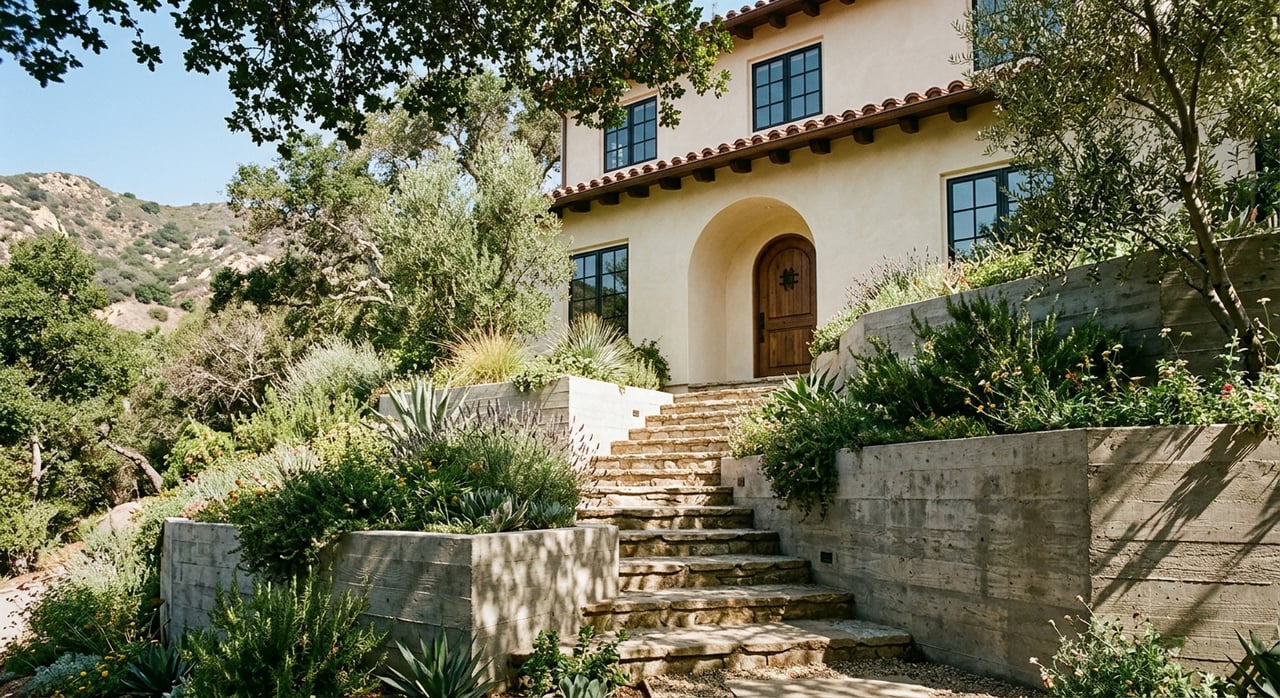
The lower historic district in Outpost Estates dates from roughly 1925 to 1930. City documentation describes about two dozen primarily two-story single-family homes, mostly Spanish Colonial Revival and Mediterranean Revival, arranged on curving streets with mature street trees, sidewalks, ornamental lighting, and a distinct sense of arrival.
That cohesion is a big part of Outpost’s appeal. Rather than feeling pieced together over many eras, the neighborhood presents as a more unified historic environment.
Outpost access and circulation
Outpost Drive is the neighborhood’s main artery. City and neighborhood sources note that it is used as a cut-through between Franklin Avenue, Mulholland Drive, and the 101, which is why traffic calming and entrance improvements remain part of the local conversation.
So while Outpost may feel polished and established, circulation still plays a role in how individual streets are perceived. A home’s exact placement within the neighborhood can influence privacy, quiet, and buyer demand.
Why Outpost commands attention
Outpost tends to appeal to buyers who value architectural continuity, larger lots, and a more formal planned-neighborhood presentation. Its relatively central access to both the hills and the Hollywood and Sunset core also strengthens its position in the market.
For sellers, that means buyers may assign a premium to homes that fully express the area’s estate character. In a neighborhood like Outpost, setting and neighborhood coherence can shape value before a buyer ever gets to the kitchen or primary suite.
How value shifts by pocket
Across Beachwood Canyon, Laurel Canyon, and Outpost Estates, pricing bands are often driven less by the general Hollywood Hills address and more by four variables: lot utility, architectural pedigree, road convenience, and privacy or view protection.
These factors carry extra weight in the hills because access conditions and preservation context can vary so much from one micro-neighborhood to the next. The result is that two homes with similar square footage can compete in very different buyer pools.
Four drivers buyers notice fast
- Lot utility: Usable outdoor areas, pads, and site functionality often affect appeal.
- Architectural pedigree: Cohesive historic styles or recognized design value can influence demand.
- Road convenience: Street width, circulation, and ease of ingress matter in hillside living.
- Privacy and views: Protected outlooks and a more sheltered setting can change how buyers price desirability.
A simple way to compare them
If you are deciding between these areas, it helps to think in terms of fit rather than just price point. Each pocket offers a different balance of identity, convenience, and physical setting.
| Micro-neighborhood | Strongest appeal | Main sensitivity |
|---|---|---|
| Beachwood Canyon | Hollywoodland identity, storybook architecture, views, trail adjacency | Visitor traffic, parking pressure, narrow streets |
| Laurel Canyon | Secluded canyon character, eclectic architecture, creative-history cachet | Road width, access, hillside construction logistics |
| Outpost Estates | Historic cohesion, estate feel, formal planned-neighborhood presentation | Cut-through traffic, preserving architectural character |
What this means for buyers
If you are buying in the Hollywood Hills, the right match often comes down to how you want a home to feel on a daily basis. A tourist-facing Beachwood block, a tucked-away Laurel Canyon lane, and a cohesive Outpost street can offer very different versions of hillside living.
That is why broad search filters rarely tell the whole story. Looking closely at micro-location can help you avoid overpaying for the wrong fit and recognize value where the neighborhood character aligns with what you actually want.
What this means for sellers
If you are selling, your home’s micro-neighborhood should shape how the property is positioned from the start. Buyers do not just compare finishes or bedroom count. They also compare access, historic identity, privacy, and the specific feel of your block.
That is where nuanced presentation matters. In the Hollywood Hills, a strong strategy highlights the exact qualities that make your address more compelling within its own pocket, not just within the larger Hills label.
If you are weighing a sale or looking for a design-minded home in the Hollywood Hills, working with an advisor who understands these distinctions can make the process far more precise. For discreet guidance tailored to your property or search, book a confidential consultation with Michael Fenton.
FAQs
What makes Hollywood Hills micro-neighborhoods different from each other?
- The biggest differences usually come down to access, architecture, historic context, lot utility, privacy, and how each area functions day to day.
What is Beachwood Canyon known for in the Hollywood Hills?
- Beachwood Canyon is known for its connection to the Hollywood Sign, its Hollywoodland identity, Period Revival architecture, scenic streets, and higher exposure to visitor traffic in some areas.
What defines Laurel Canyon for homebuyers?
- Laurel Canyon is defined by its wooded canyon setting, varied architecture, secluded feel, and the practical importance of road access, ingress, and hillside site conditions.
What stands out about Outpost Estates in Los Angeles?
- Outpost Estates stands out for its planned-neighborhood character, cohesive historic architecture, estate-like presentation, and relatively central position between hillside living and the Hollywood core.
How does micro-location affect home values in the Hollywood Hills?
- Micro-location can shape buyer demand before finishes are even considered because buyers respond differently to road convenience, privacy, view protection, lot usability, and neighborhood identity.
Should buyers compare Beachwood, Laurel Canyon, and Outpost Estates differently?
- Yes. These areas may share the Hollywood Hills label, but each offers a different balance of atmosphere, access, architectural style, and market appeal.